Design Lead at Camden Council
user research ui design ux strategy information architecture analytics ux management
About Camden Council and the team
Camden is a London inner-city borough of diversity and contrasts. Covering large parts of central London, it’s the home of global corporations like Facebook and Google, it includes prestigious universities and a large student population, and it has a number of exclusive residential districts as well as areas of relative deprivation.
The Covid pandemic had a massive impact on how local authorities delivered their services to residents and businesses. In 2021 Camden Council decided to accelerate an existing programme of digital transformation by setting up a new team with professional digital design, build, and delivery capabilities. Digital Products and Services (DPS) was tasked to follow a rigorous user centred design approach, to adopt and promote agile work practices, and to strategically align digital products and services.
About my role
The initial team consisted of only the Head of DPS, the Delivery Lead, and myself appointed as the Design Lead. One of my tasks was to build up the design function to be formed of three product designers (lead and mid-weight), four content designers (lead and mid-weight), and a senior user researcher who were all subsequently recruited and who I managed and mentored until the end of my consultancy appointment.
Being initially the only designer, I worked in a hybrid consultancy and hands-on capacity. I helped shaping the team strategy from a design perspective and I championed user-centred design across the wider organisation. And, being initially the only digital designer, I tackled design challenges and user research activities from day one.
Focus areas of my day-to-day work were:
- Preparations for the re-design of the Council’s website in order to increase reach and value for residents and businesses in Camden’. This work included research into user needs and access barriers;
- Introduction of a design-system to preserve overall design consistency, best practice usability and accessibility, and reduce design and development efforts;
- Evaluation of other Camden Council websites in order to develop a product design framework based on the new Design System that would optimise design and build efforts and introduce best usability and accessibility standards across Camden’s digital estate.
”Ulf’s design leadership and hands-on work were instrumental to getting our new Digital Products and Services team established. He showed expertise and flexibility across design disciplines and always with high ethical considerations and inclusivity at the heart of his approaches.”
Research into user needs and barriers
Prior to hiring a permanent user researcher for the DPS team, I carried out a number of user research activities. The overall aim was to better understand the needs of residents and businesses and to identify access barriers for members of underserved communities.
Research activities included a series of interviews with members of the public, screened for our target audience and selected by an external agency. One particular exercise focused on young adults in social housing who, despite being digitally active to an average or high degree (social media, email, websites, and apps), expressed reluctance to use Camden’s online channels for engaging with council matters. Most important insight of these interviews was that the Council’s applications and processes regularly failed users on most basic levels. Resulting in a fundamental lack of trust in its online offerings, users preferred calling the council directly whenever needed.
I also prepared and conducted a large-scale Top Tasks survey with the aim to identify the 5 to 10 most critical service and information needs across Camden’s population. The outcome of this exercise proved to be helpful for facilitating prioritised user journeys across the website and delivering a more user-centric experience.
Further rounds of user interviews were conducted during the design and development phase of the website (see below). We collected immediate feedback on proposed design solutions In 30 dedicated sessions with Camden residents from diverse backgrounds.
Website redesign
Aim of re-designing camden.gov.uk was to make the website and its associated services easier, clearer, more inclusive and accessible so that they meet the diverse needs of Camden’s communities.
In addition to a number of user research activities (see above), I conducted a comprehensive UX expert review that covered the site’s content and information architecture, navigation and findability, as well as overall usability and design. Underpinned by insight from Web analytics (Google and SiteImprove) I concluded with a number of recommendations that framed future re-design activities.
Findings from the user research and the expert review informed ideas for the design of new page templates for article, category and landing pages such as the proposed homepage.
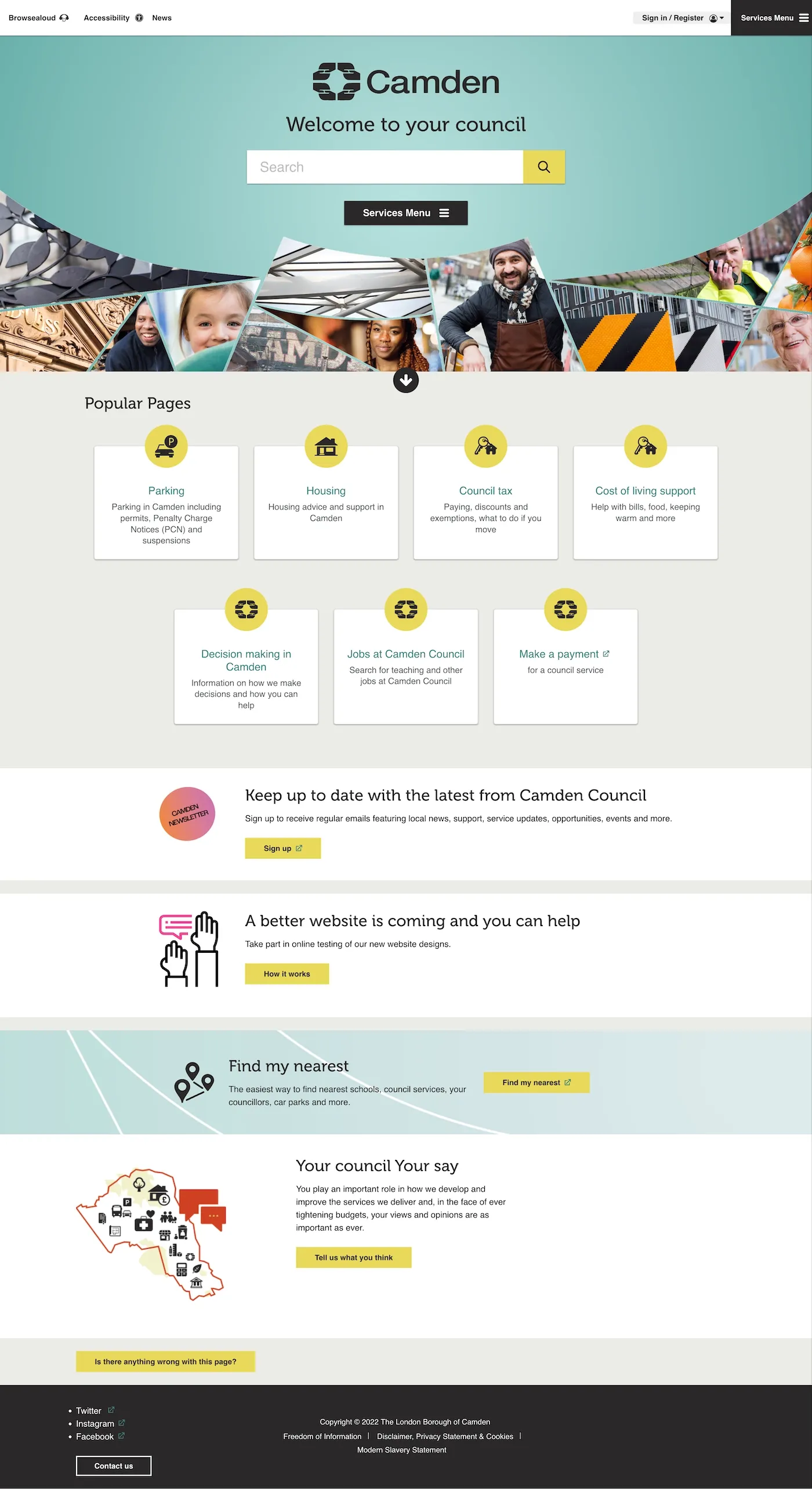
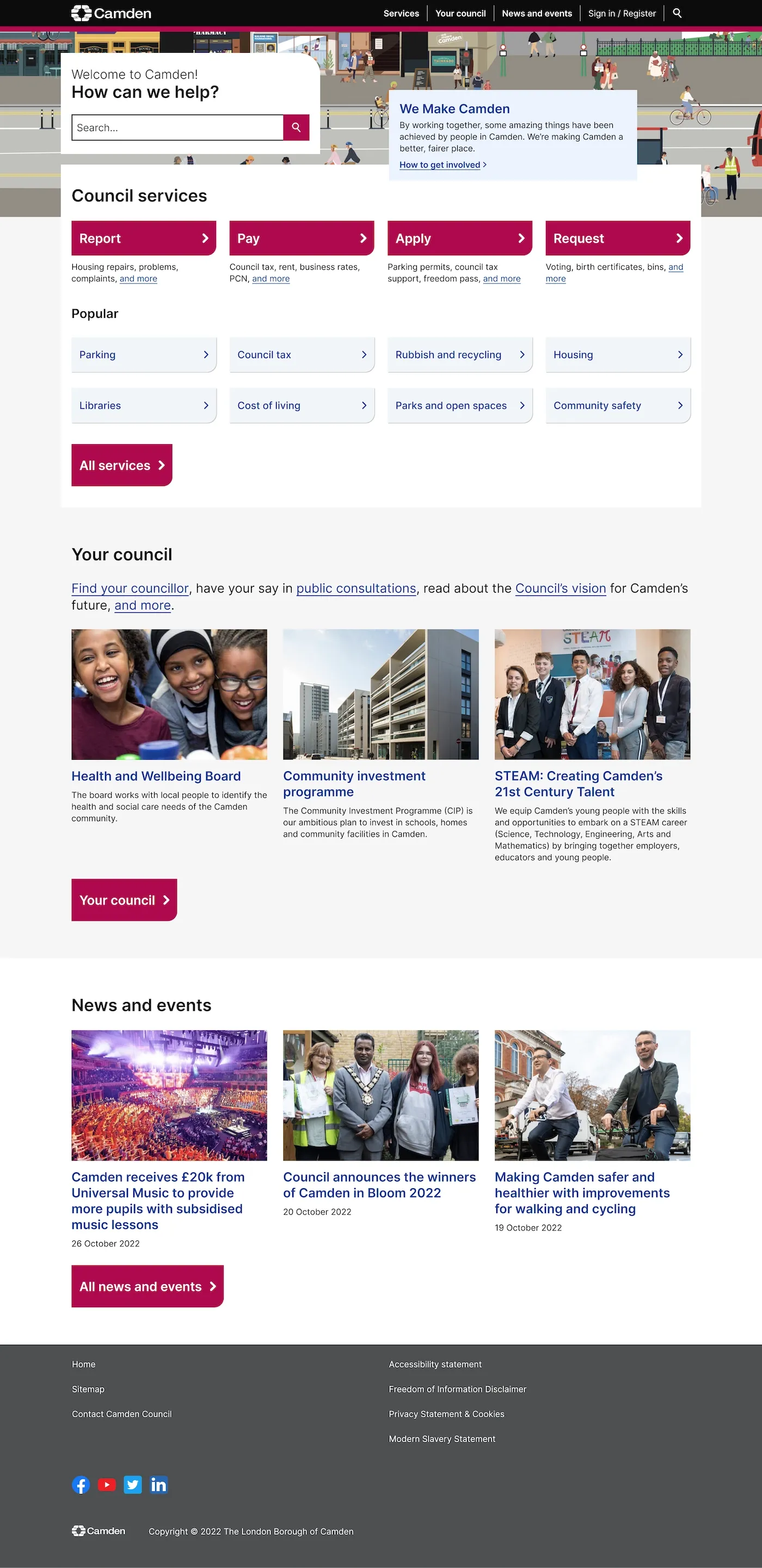
Example: Services landing page - Design rationale
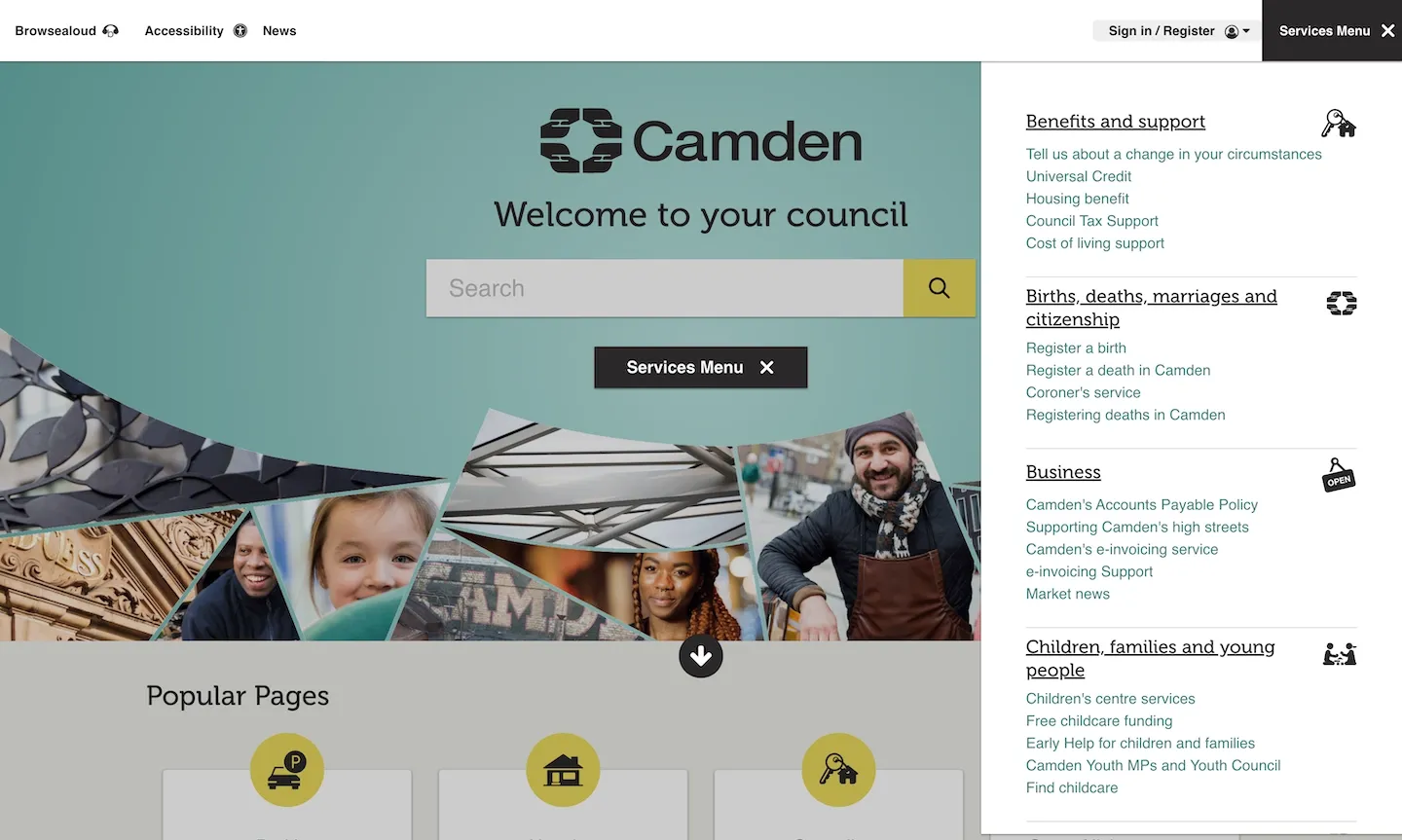
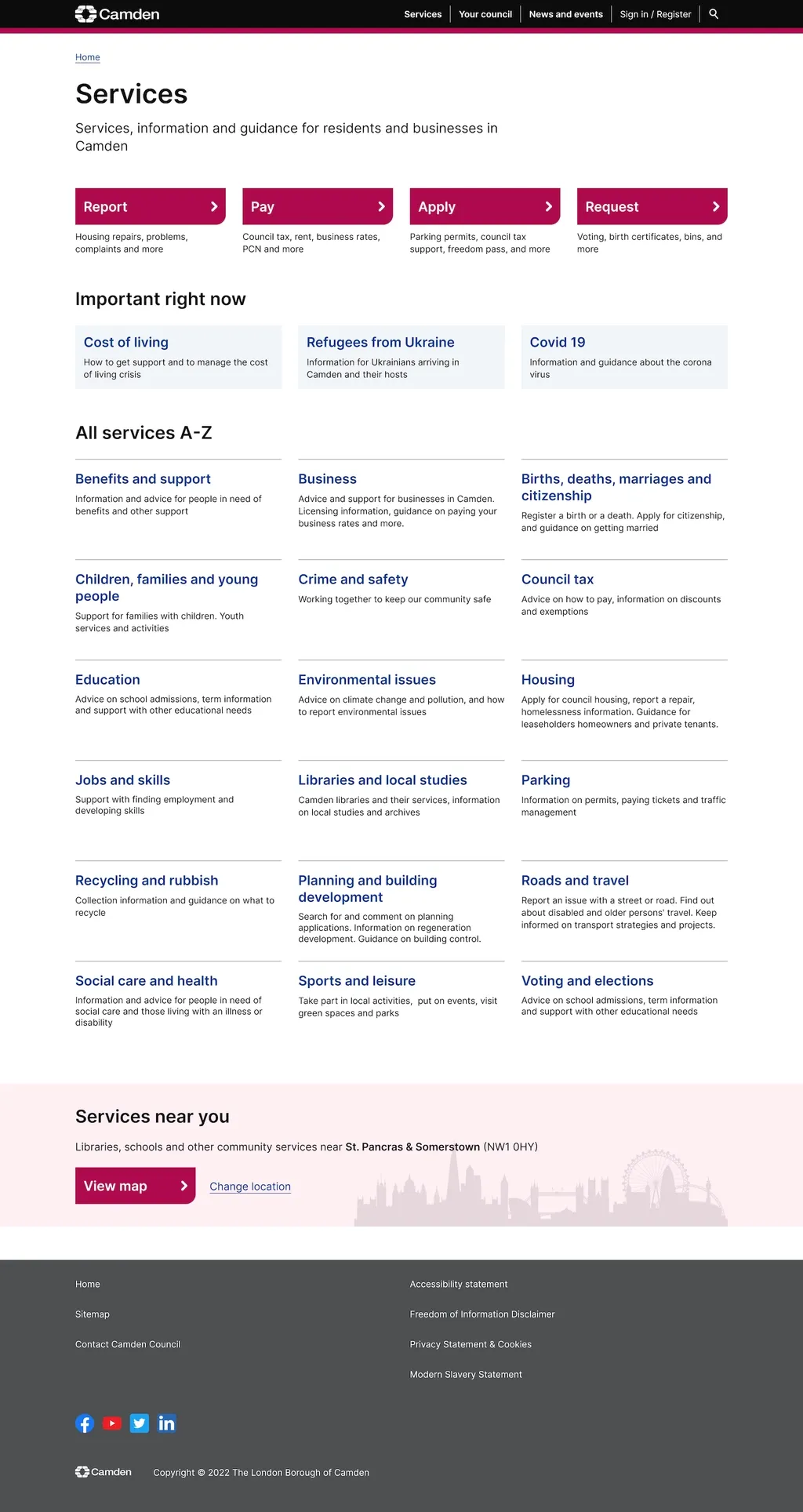
An example of how data and research helped to propose a more user-centric solution is the design of a dedicated Services landing page to replace the ‘All services’ fly-out menu.
Analytic data showed that the existing menu was under-used and did very little to navigate users to the right destination. Subsequent interviews and feedback sessions with users confirmed that the fly-out menu with a list of about 20 links to category pages was rather unhelpful.
Further thoughts have led to the idea of proposing a dedicated Services landing page to replace the ‘All services’ dropdown menu:
- Measured in clicks/taps, the ‘interaction cost’ for accessing the services landing page is the same as for accessing a menu, with the landing page having the capacity to be more helpful than the menu (see below);
- Category switching from anywhere on the site is not a key user need because people rarely have more than one task in mind when visiting the website;
- Signposts to most popular destinations on the home page and on the search input panel of the site provide quick access to high volume user tasks;
- A dedicated Services landing page in conjunction with sibling landing pages for other site areas (‘About Camden council’ and ‘News and events’) helps framing the structure and the content of the whole site.
The Services page was designed to more easily find information through a number of alternative ways, for example task and location based navigation, or by promoting news-related services, such as Covid, Ukraine refugees, or the cost-of-living crisis.
User feedback sessions confirmed that a dedicated Services landing is more helpful and inclusive than a Services menu, particularly for users who are new to Camden or to the UK, or who have limited English proficiency.
Building the Camden Design system
The introduction of a design system was made a priority for the newly formed DPS team with the objective to promote overall design consistency, reduce design and development time and prevent accumulation of development debt.
Promoting best practice accessibility and usability, theCamden Design System had to cater for two types of communication:
- Support users in finding, understanding, and acting on all Council matters quickly and easily, and
- Support the council in engaging Camden’s communities with its missions, initiatives, and processes/decision-making.
We decided to build the Camden Design System on top of the central government’s gov.uk design system, customised and extended to accommodate for the two types of communication needs. We imported styles and components wholesale, introduced new typography, colours, and breakpoints, amended spacing rules to harmonise with the chosen font, but we preserved best-practice responsive behaviours and interaction patterns for complex components like tables, tabs, and accordions. We then employed the new components to build pages and user journeys that we could regularly test with users to further iterate our design approach.
While being developed and closely associated with the website redesign project, the Camden Design System was seen to become a product in its own right, maintained and developed by a dedicated team in order to deliver the core for Camden’s future Websites.
Product design framework for Camden Council’s websites
Camden currently has a digital estate that consists of 68 different microsites and domains, and over 120 online forms, delivered through multiple providers and platforms. Historically, websites and microsites have been commissioned by individual services, built by either internal contractors or external agencies. As a result of this, there is an inconsistency of styles and structures, often create jarring experiences in common user journeys, and more often than not falling short of usability and legal accessibility standards.
I evaluated a sample of existing websites in order to identify the different types of products and to define a redesign approach that embraces accessibility and re-usability with the new design system at its core. Aim of this exercise was to provide a solution for consolidating and aligning existing sites with a single design language and best-in-class accessibility and usability standards. Focussing on websites that were published in the past five years, I ignored those that did not appear to have a clear product purpose or measurable goals.
The analysis of audiences, types of content, and service needs showed that the majority of products could be addressed with new or variants of existing design system building blocks. Some of the content could be incorporated into the new website, other products would either live as a subdomain, or if complementary to a wider media campaign, as a standalone site with its own URL. The introduction of a slim ‘super-header’ would communicate the relationship with Camden and allow for site specific navigation.
The following three main products types emerged from the analysis:
- Service hub pages
- Local offer sites
- Comms campaigns
Service Hub pages
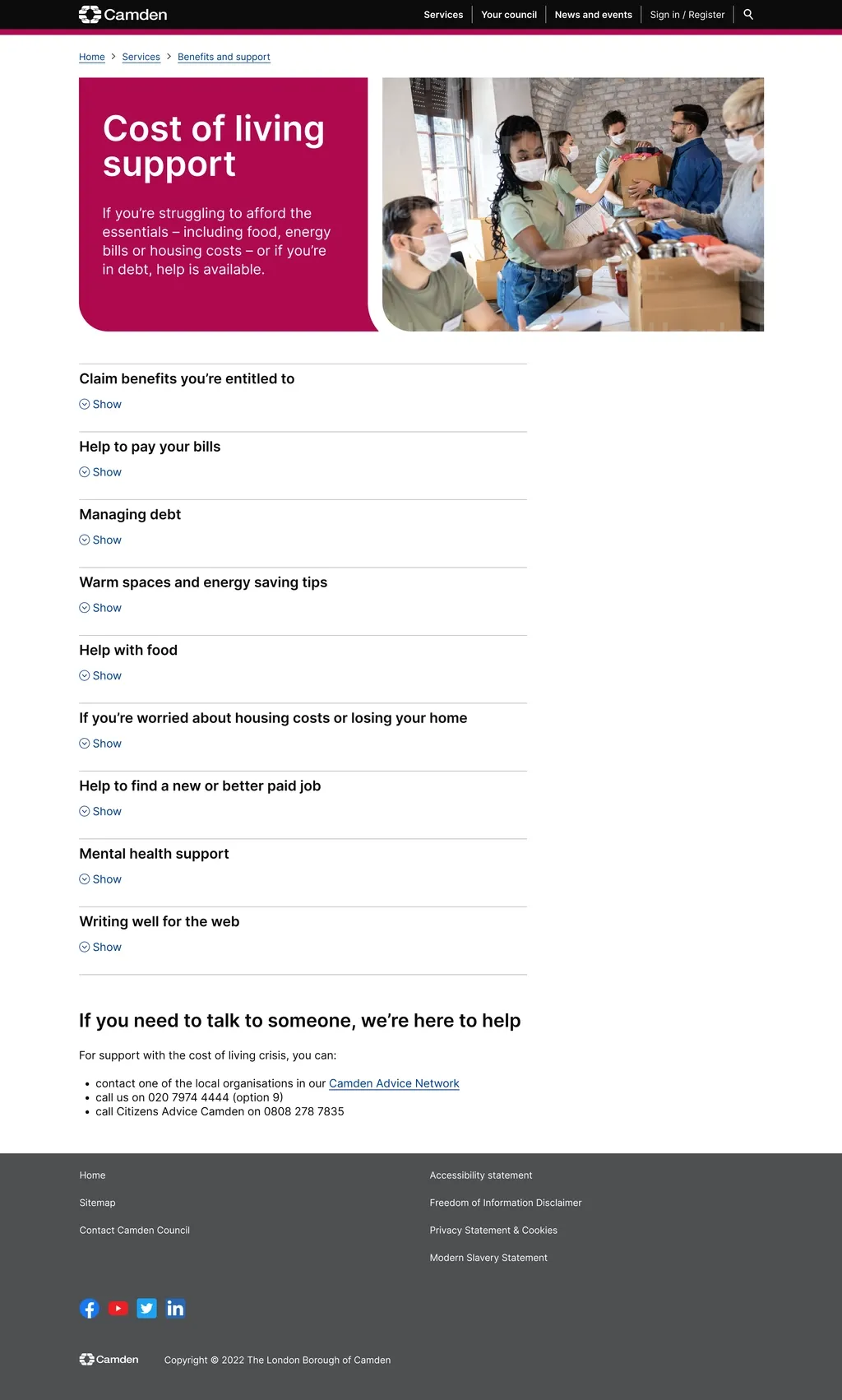
A page that helps users finding service information about a particular theme, for example ‘Cost of living support’. Individual articles that live across different service categories (Here: Benefits, Housing, and Health) could be navigated to from a single page. Service hub would be integral to camden.gov.uk, promoted for example on the Services landing page or from related articles.
Local offer
Local offer is a the name of a group of websites that provide information and services for specific user groups, such as young people or parents of young children or children with special educational needs (SEND). Apart from information about related Council services, they can include lists and interactive maps of related organisations in the borough and they promote upcoming events in the borough. Local offers could be delivered through subdomains of camden.gov.uk
Comms campaigns
Comms campaigns have a much more promotional character than service products, they aim to engage Camden’s communities with the Council’s missions, initiatives, and their decision-making. Comms campaigns are more likely to be sub-branded and to use rich media content. They could be delivered either through subdomains or as standalone domains with a custom URL.
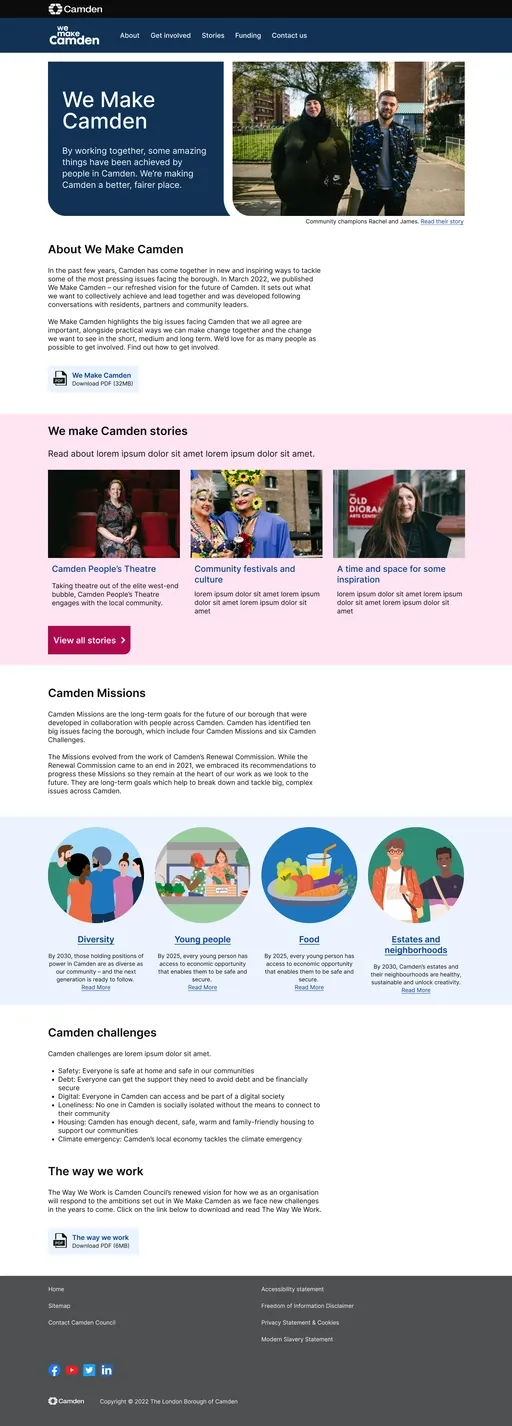
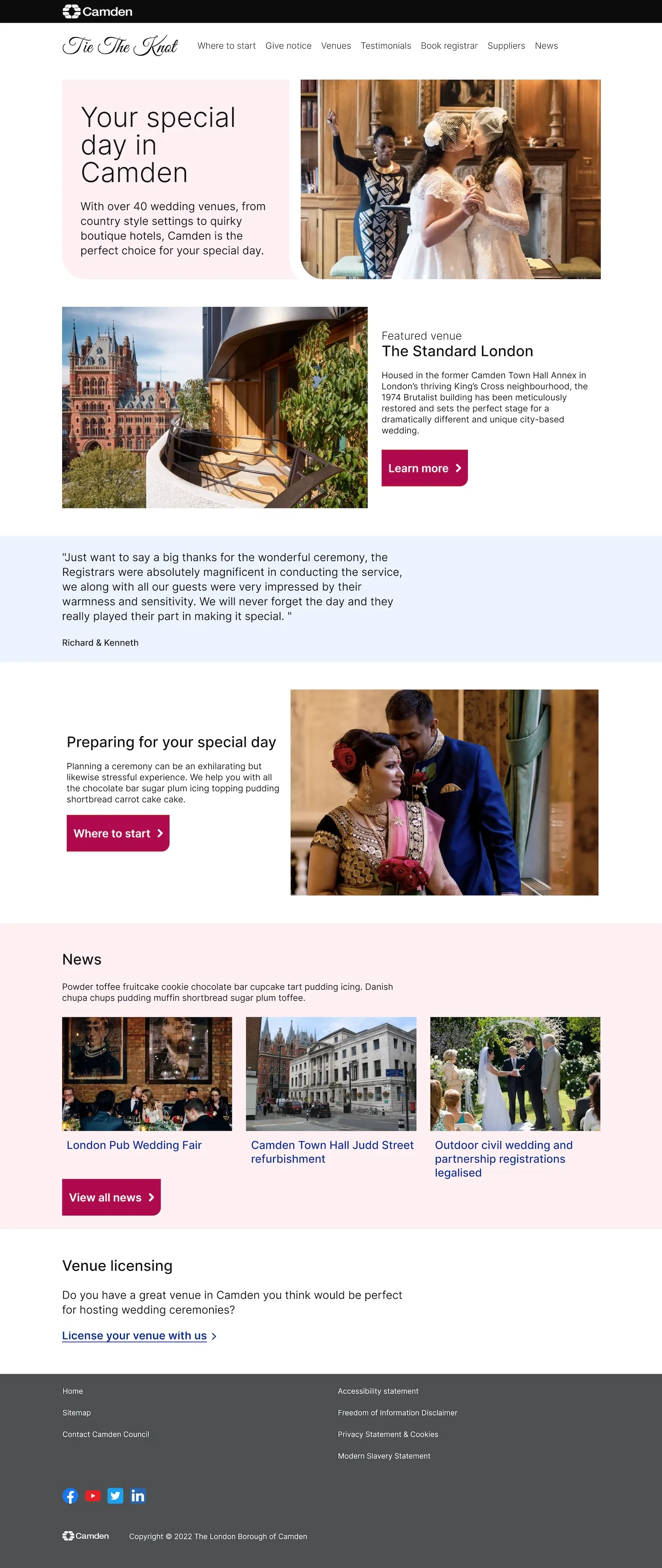
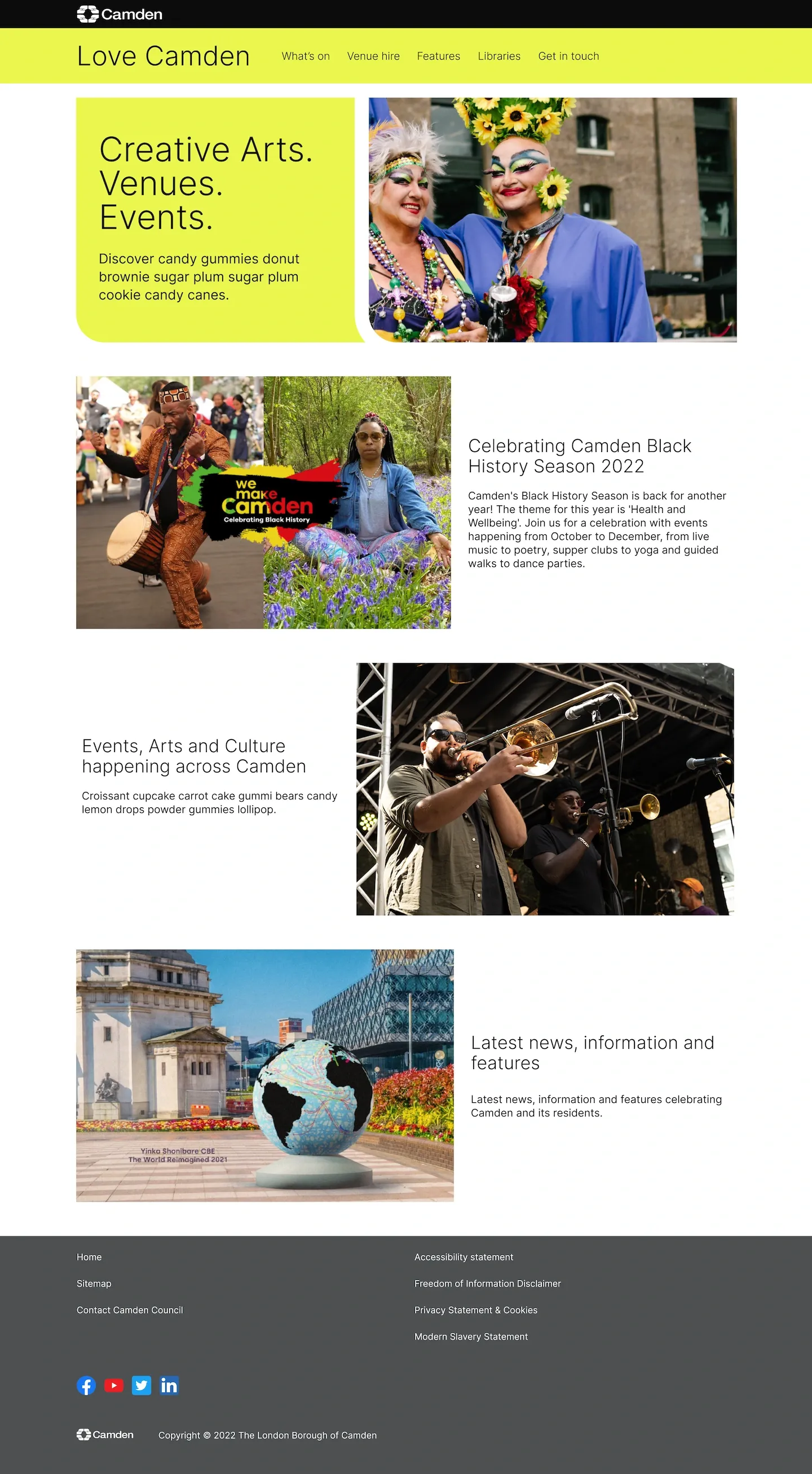
I delivered the product design framework at the end of my assignment in December 2022 to be further discussed with the Comms team and within the wider organisation. Next agreed steps were to design and build a new SEND Local Offer site and test it with parents and carers.